
Commons AI – 2026 Edition
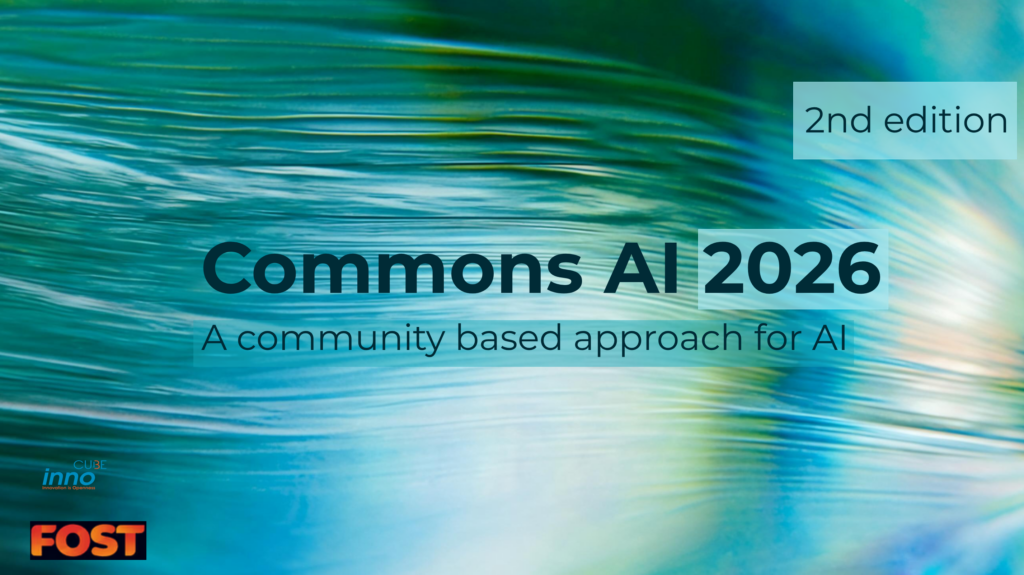
Commons AI is an annual conference dedicated to a community based approach for AI. It will take place on December 1, 2026 at the CNIT in La Défense, as part of the Future of Software Technologies event, which runs from December 1 to 3.
Program and Registration
The program is online: five sessions on December 1 from 11:00 am to 5:30 pm, mostly in English. Registration is free with the code COMMONSAI149RRR177 and gives access to the whole FOST event from December 1 to 3, 2026.
With the button below, the code is prefilled on the FOST website: just click “Redeem” to apply it.
Commons AI brings together people engaged in the study and/or support of digital commons who are exploring and working toward the creation of Artificial Intelligence (AI) through a digital commons approach.
By “digital commons,” we mean a form of collective action that brings together a community of diverse actors, implementing governance rules to develop and sustain immaterial resources and maintain the community.
We adopt a broad understanding of openness and AI, not limiting it to Generative AI on the one hand. And recognising, on the other hand open technologies and open practices at different layers of the AI stack, including open source software, open weights, open data, open hardware, and open science (open digital artifacts).
A commons-based approach to Artificial Intelligence involves examining three key dimensions:
The resources involved in the AI stack, without limiting them to models and data.
The challenge is to consider the entire spectrum of AI technologies and applications, including the AI stack in its entirety (model, architecture, interface, data, standards), as well as the hardware component.
The governance rules applying to these resources and the community.
With the aim of ensuring the long-term viability and sustainability of the whole, whether guided by the development of legal standards (such as new licenses or legal structures) or by established practices.
The ecosystem that develops, manages, maintains, and regulates these resources at various scales, along with the values it embodies.
Moving beyond the ideal of free circulation of resources sufficient to ensure their sustainability, this involves considering community dynamics and the social values embodied (integrity, transparency, environmental and social responsibilities, inclusivity, etc.), as well as the conditions for a sustainable commitment by stakeholders to make the efforts needed to maintain and develop them.
A collaboratively developed 2026 edition
The first edition in 2025 brought together about fifteen speakers. This second edition has been co-created. The format includes talks that provide context and frame the issues (20 min), presentations of inspiring initiatives (10 min), and time for audience participation.
The call for proposals closed on September 15, 2026. It shaped the five sessions of the program around the themes below.
Proposed themes
Collateral effects of AI on open models
AI and Participatory Dynamics
The Material Dimension of AI and Commons Issues
Multi-level Public and Industrial AI Policies and Governance
Creation of Data Commons
Trust in AI
For a detailed overview of the topics, please refer to the call for proposals (PDF).
Would you like to support this event?
Would you like to become a sponsor?
Registration
Free registration with the code COMMONSAI149RRR177.
Organizing Committee
- Vincent Bachelet (Panthéon-Sorbonne/Inno3)
- Jeanne Brétécher (Social Good Accelerator)
- Ramya Chandrasekhar (CNRS/Open Knowledge Foundation, Université Paris Panthéon Assas)
- Manon Galle (ANCT Agence Nationale de la Cohésion des Territoires)
- Nicolas Jullien (IMT Atlantique/Marsouin)
- Elsa Le Duigou (DINUM)
- Cailean Osborne and Yann Lechelle (Probabl)
Coordination
Commons AI is coordinated by Inno3 (Célya Gruson Daniel and Benjamin Jean) with the support of Mehdi Medjaoui and the FOST team.

Sponsors
Supported by EuroCommons
Find out more
If you have any questions about the event or a specific request, please contact Célya Gruson Daniel by email: cgruson-daniel@inno3.fr