A first of July marked by the commons and sovereignty
A single day, two events – and the very clear sense that a shift is underway. On 1 July 2026, the Digital Sovereignty Summit and the launch of EuroCommons by the Caisse des Dépôts each say, in their own way, that digital commons and Open Source have changed status: once a tolerated alternative, they are becoming the strategic component of a digital autonomy still to be achieved. A look back at what this owes to a now-mature movement, and at the conditions that remain to be met for it to hold.
Sometimes you have to pause to measure and appreciate how far we have come. In recent years, the lines have moved at a pace that few of us would have dared to predict or hope for, and these past months have been the most intense. In a geopolitical context that lays bare balances of power and (abuses of) dependency, the benefits of Open Source and digital commons are now unanimously recognised. This 1 July 2026 is a striking illustration: two events, one and the same direction. Digital commons, through Open Source, are the main path to a regained sovereignty.
Two notable events (conveniently close to one another – a chance to enjoy a few minutes’ walk):
- The first was the Digital Sovereignty Summit (30 June to 1 July 2026). Taking part in the afternoon round table “Open source versus the GAFAM: credible alternative or illusion?”, alongside Rémy Fabé (eXo Platform), Alexis Kauffmann (ministerial lead for free software and digital commons, French Ministry of Education) and Denis Lafont-Trevisan (OpenCapital.vc). A chance to recall that Open Source is a well-defined concept, and that this model can help build digital commons as well as established business models (compare PostgreSQL, in everyone’s hands, with MongoDB, valued at more than 8 billion). It was also an opportunity to stress the contribution reflex and pooling (TOSIT) to “de-risk”, in the wake of the European “open source first” package, in line with the analysis “Sovereignty without rivalry, the Open Source way?“, the post “Open to last: rethinking public digital infrastructures in the age of the commons“, and our contributions to the European Commission’s consultation on open digital ecosystems.
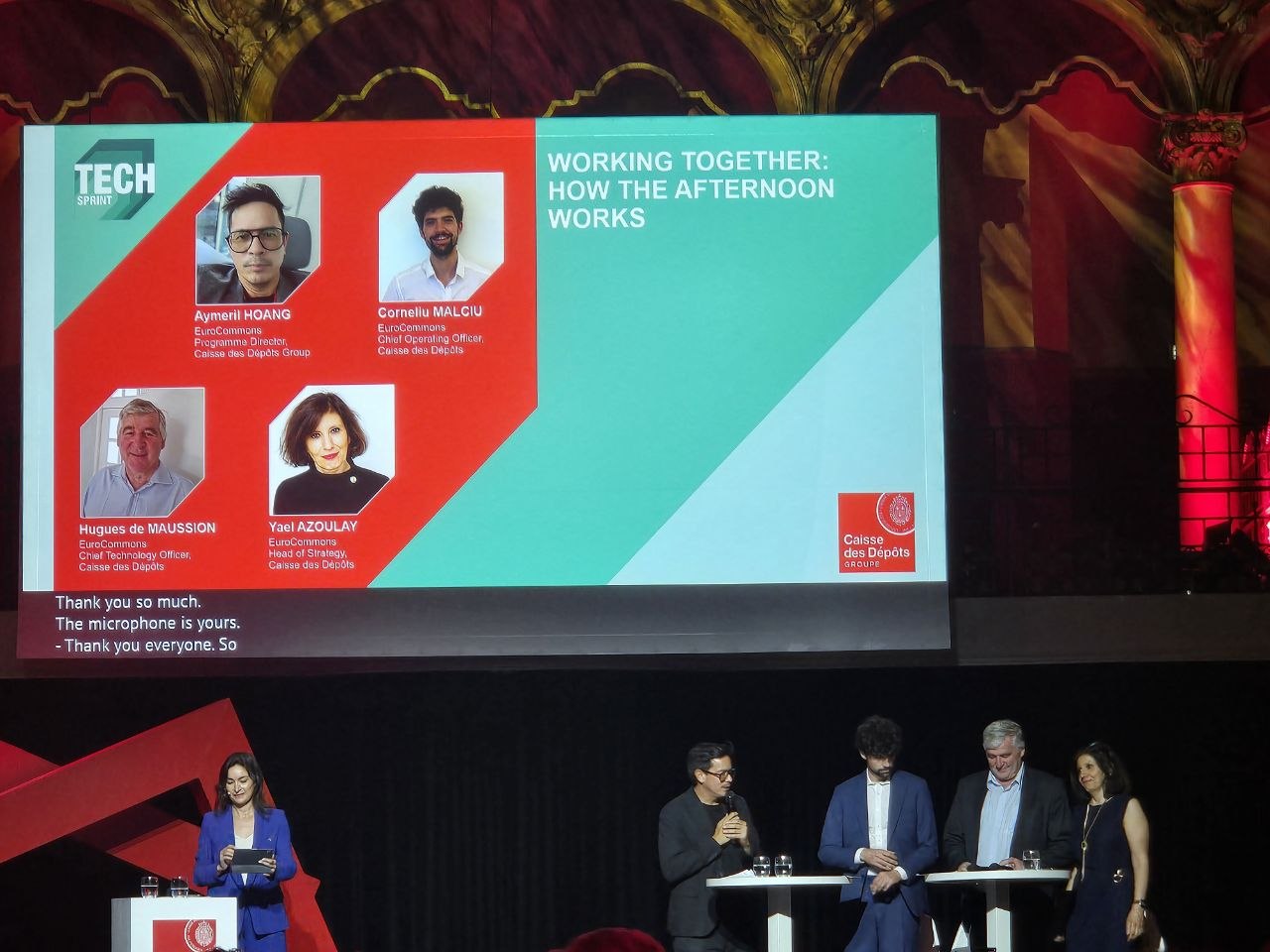
- The launch of EuroCommons and the kick-off of the first TechSprint. If there is one signal to remember from today, this is it, driven by the Caisse des Dépôts. Seeing an actor of this weight and nature commit so strongly to the commons and Open Source is all the more memorable. Backed by the Horizon numérique 2030 strategic plan (18 billion euros), EuroCommons brings together some 300 European organisations (CIOs, Open Source vendors, foundations and public institutions) to form eleven coalitions around critical software building blocks (across themes such as workstation, communications, virtualisation, identity and directories, and security) and to commit to migrating together. The first TechSprint, launched on 1 July, opens a series of action cycles lasting a few months, at the end of which the organisations involved will be able to move to open and sustainable European commons.
Update note (17 September 2026): MongoDB was distributed under the AGPL-3.0 until October 2018; versions released since 16 October 2018 are under the Server Side Public License, which the Open Source Initiative does not recognise as an Open Source licence. The valuation cited refers to the company MongoDB, Inc., whose market capitalisation was around 30 billion dollars in September 2026.
Investors as new players “in the room”
To put it politely: Open Source and, more broadly, open resources have always struggled to find their place with funders and investors. Whether the Caisse des Dépôts (or the Banque des Territoires), the DGE, Bpifrance or, to some extent, the SGPI, open models were long seen at best as counter-models to capital-driven success stories, and at worst as artisanal projects (not compliant with banks’ assessment grids). The model of pooling and of the commons through Open Source (contributing users rather than shareholders) has always been hard to “sell”, which, in our experience, has slowed the growth of European Open Source players: the sustainability of Open Source projects has often depended on the perseverance of a few actors, in the vast majority of cases the solution vendors.
When we explored the relationship between the commons and money (public value, total cost of ownership, funding maintenance as much as innovation) during the panel “The profitability of digital commons” (at Numérique en commun[s] 2025), the round table clearly highlighted the importance of thinking about project sustainability from an economic standpoint, while clarifying what belongs to the market and what belongs to the infrastructure to be maintained (or at least guaranteed) by the public sector (this was also the announcement of the EDIC Digital Commons).
The intersection between end users (notably large private groups – CEOs and CIOs), vendors and digital commons is an even more complex and rarely addressed topic. This is precisely what this shift corrects. That an actor such as the CdC, the state investor, chooses to “invest” in – and thus validate – the field of the commons is not merely an endorsement: it is a sign that society has changed, that it is becoming increasingly possible to embed these approaches over time, with the resources they have so often lacked. Of course, everything remains to be done and we still need to move from intention to action, but it is already proof that the economics of free software has (finally) evolved (yes, some had seen well ahead of time that free software and Open Source could durably transform our society).
Does coalition lead to the fork?
The notion of coalition raised questions about the definition of Open Source, the role of Open Source vendors, and the value of “taking back control” – if need be by force – of Open Source solutions that are insufficiently sovereign. The European Strategy itself now envisages equipping itself with a capacity to fork critical projects in order to ensure genuinely shared governance. Let us keep in mind, however, that the Open Source ecosystem was built over forty years, and that many economic actors sought and found a sustainable model in it: the point is not to discourage this community movement by ignoring that effort and those resources, just as it is necessary to help them contribute to the new momentum. The transition is necessary and useful; it must be thought through and supported to be virtuous.
Open Source is not incompatible with a vendor model, and we are fortunate to see many success stories in France and Europe (see for example the CNLL directory). That said, some vendor models and projects remain on very closed patterns (often more out of necessity than choice) and are not necessarily compatible with community logics; this is as much a matter of money as of governance (the two being generally closely linked). The whole challenge is to enable all actors (buyers and providers) to meet and share, in full transparency, their respective constraints and solutions. The two models do not necessarily exclude one another.
A few additional remarks:
- Yes, Open Source offers that “ultimate weapon” that is the fork. But those who have already launched, or even forked, a project know that it is most often a loss for everyone. The launch of Euro-Office, an aggressive fork of OnlyOffice announced in late March 2026 in Berlin by a coalition of European vendors and hosting providers (including Nextcloud and IONOS), is an illustration that leaves a bitter taste. Nonetheless, let us remember that Open Source customs call first for dialogue and for seeking consensus, and that it is only when governance is not enough, or does not allow consensus, that the fork may be considered.
- Open Source makes the “free-rider” behaviour easy – those actors who do not take part in a collective effort but enjoy all its benefits. It is worth reminding them that the licences do indeed allow use without financial consideration, but that the absence of reciprocity or financial contribution (or simply funding intermediaries rather than the projects’ maintainers) risks drying up the project and discouraging the initial contributors, in favour of other actors who will no longer have the collective interest as their goal.
The aim of this TechSprint addresses this first challenge of dialogue – simple to state and more demanding to implement. It is about bringing together, over a short period, actors from different backgrounds to lay the foundations of shared commons. The point is not to produce a pitch, but to concretely kick-start the definition and setting-in-motion of coalitions able to carry these resources over time (governance and concrete cooperation will come in the following months). After a morning of statements, the whole afternoon was devoted to work in coalitions; it is there, around each critical building block, that the first shared specifications and the next migration steps must emerge.
What futures for the coalitions that have been started
The value of the exercise was obvious: nothing replaces sitting around the table, confronting real needs and building together. But while common sense suggests the soundness of such an approach, its complexity should not be underestimated: bringing varied interests together, articulating legal, technical and organisational constraints, and staying the course beyond the initial enthusiasm. Discussions remain intense, with nonetheless the challenge of changing the current situation without necessarily ignoring everything that already exists.
The structuring work will follow; three requirements seem to us to need to be met:
- 1. An open and shared resource, legally as much as technically. One does not go without the other: an open licence without real technical access (or the reverse) is not enough. The balance is then played out in the scope: distinguishing what must be maintained collectively from what is incidental, without confusing the end (co-building an open and shared foundation) with the means (which may sometimes rely on exclusive licences). Not all organisations have the same stakes, and the place of very small businesses and small structures in contribution should not be forgotten.
- 2. A real and organised community. It is the community that ensures sustainability; without it, even the best-designed resource eventually fades. To be strong, it must be representative and bring together technology providers as well as end users, and direct and indirect funders. A commons that is not used withers. Particular care was taken, moreover, to ensure that these various actors (TOSIT, MEDEF, APELL, CNLL, OW2, Eclipse Foundation, etc.) were present and active.
- 3. A capacity to last through standardised and fair rules, carried by two inseparable engines: effective governance and appropriate funding.
It is precisely the triptych of resource, community and governance that structures the definition of digital commons (see the governance canvas for digital commons). It is also a deliberate stance to consider that much of the recipe for success already exists and only asks to be applied, without reinventing what already works (in the spirit of the 2026 edition of EOLE 2026, which reminds us that free software has been pursuing digital autonomy for forty years, long before the word “sovereignty” entered the vocabulary of public policy).
Finally, the beginning is the community. A commons is not decreed; it is brought to life. And for it to live, we must remain benevolent and allow everyone to contribute to an exercise that is collective by nature. The EuroCommons project is a call to dialogue and to setting these coalitions in motion. Every contribution counts, whatever its form and scale.

![Round table moderated by Benjamin Jean at Numérique en Commun[s] 2025](https://inno3.fr/en/wp-content/uploads/sites/2/2026/05/20251029_141956-1-343x350.jpg)