AI governance: what solutions to counter power asymmetries between AI producers and users?
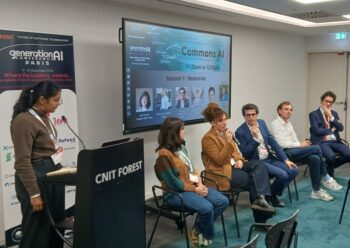
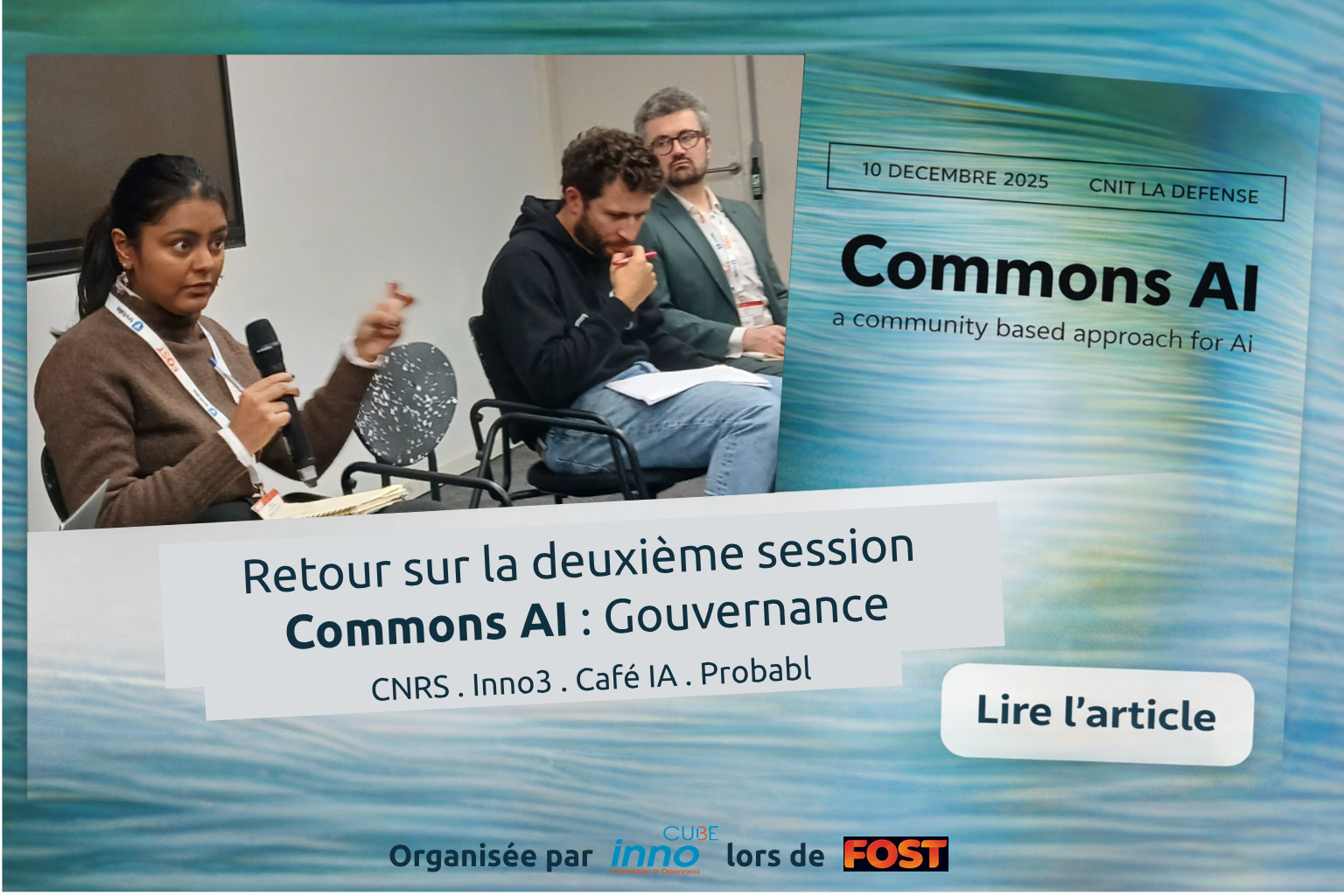
On 10 December 2025, the Commons AI (in French) day was dedicated to Artificial Intelligence in a commons-based approach. It took place at the Future of Software Technologies event, at the CNIT in La Défense. Three sessions were organised over the course of the day to cover each of the three pillars of the commons: 1/ resource, 2/ community and 3/ governance. The fifteen interventions throughout the day showcased ongoing initiatives and avenues of solutions for AI more respectful of the principles of openness and the commons. Each session was the occasion -- beyond the talks themselves -- for fruitful and dynamic exchanges between speakers and audience. We propose, in three posts, an overall account of each session and a summary of the interventions.
This second post is dedicated to AI governance issues.
See also the first post already online: “Commons AI: an essential need for access to quality data“.
In the second “governance” session, four speakers presented a diversity of initiatives at work, or ongoing reflections, aimed at rebalancing the power dynamics between AI model producers/owners and users of these systems. It is widely accepted that we find ourselves in entirely asymmetric power dynamics between AI deployers and increasingly “captive” consumers.
The role of the state and the means at its disposal to restore a balance can be questioned. Less than twenty years ago, the Hadopi law severely punished copying and scraping, while these very same practices are today commonplace among major foundation models -- and indirectly recognised as signs of innovation. Today, lawsuits against Big Tech are being initiated by individuals, not by governments. A look at the controversies around AI training data, in terms of intellectual property and personal data protection, leads to this observation. It is indeed a few private organisations that have stood up to the abusive practices of large foundation models -- for instance, the ongoing lawsuits against Meta or GitHub.
Update note (17 September 2026): the so-called Hadopi laws (Law No. 2009-669 of 12 June 2009 and Law No. 2009-1311 of 28 October 2009) target the unauthorised online sharing of works, notably on peer-to-peer networks; they do not deal with scraping. Text and data mining falls under other rules, including Articles 3 and 4 of Directive (EU) 2019/790.
Today, what avenues of solution are emerging? Several licences are being developed in an ethical approach to counter certain uses. Even though this multiplication of licences raises questions about their actual effectiveness, they crystallise the main demands of various AI users (researchers, minority communities, etc.) seeking to protect themselves. As such, they help prioritise the actions to be taken.
Fiduciary mechanisms are now presented as an opportunity to exercise this control over AI producers, by asserting consumers’ rights and ensuring they are respected. Data trusts are seen as an interesting avenue, which now needs to be operationalised in French law by relying on -- or even reshaping -- existing structures such as endowment funds (fonds de dotation). The status of organisations producing and operating the technological building blocks underlying AI systems is also questioned: Probabl thus illustrates how the maintenance of the essential building blocks of AI projects (using the scikit-learn library) is an issue that has found a balance between respect for open source community dynamics and sufficient economic support for the project.
The question of the commons remains paramount in offering an alternative path and playing the role of challenger in the current power dynamics, in order to shift the lines. In this respect, the recent creation of the EDIC Digital Commons consortium at European level offers fertile ground for the emergence of alternative paths.
Below you will find a summary of the interventions, along with the audio and the associated presentation.
Legal frictions in reusing the open web for AI training
With Ramya Chandrasekhar (Centre Internet et Société / CNRS)
Ramya Chandrasekhar, researcher at the Centre Internet et Société (CNRS), conducted a study in 2024 on the openness issues associated with the use of training data for AI models. In collaboration with inno³ and the Open Knowledge Foundation, she studied the frictions linked to copyright and data protection issues. Several controversies have indeed arisen from the use of copyrighted data by foundation models that draw on web data while overstepping intellectual property rules and individual user rights. This now poses a major problem for the open web, which finds itself used more than it can produce in the way of resources. The sustainability of this open web space is thus called into question. Several controversies can be cited around the use of public data -- for instance, around source code whose licences were not respected (Doe v. GitHub) or the use of content from “pirate” libraries (Kadrey v. Meta).
To counter this pillage, a series of initiatives has developed specifically around licence proposals. The Open Source Initiative, for example, has published its definition of Open Source AI systems, translating the four freedoms of the free software definition into this context. Other licences have appeared with specific usage features. For example, the RAIL licence (Responsible AI License) sets out a restricted usage framework to limit certain uses; the Montréal licence develops a new taxonomy of data uses; the Open Data Commons licence categorises several specific options based on personal data; AI2Impact from the Allen Institute, or the Nwulite Obodo licence, propose a dual licence based on geographic origin (Global North / Global South).
This proliferation of new licences raises questions about their interoperability and application. However, their specifics are a reflection of the needs of the commons. This frictional situation is therefore the very basis of possible action and of the beginnings of an interoperable structure.
Listen to the audio (in English) -- Slides
Governance of AI data: the fiduciary model as a path to collective and controlled value creation
With Vincent Bachelet (Université Paris-I-Panthéon-Sorbonne, inno³)
Vincent Bachelet, consultant at inno³ and post-doctoral researcher at Université Paris-I-Panthéon-Sorbonne on the OpenLLM project, revisited the possible applications in the AI field of his thesis findings on the legal valorisation of digital commons.
The question is how to ensure respect for intellectual property rights on the data used to train AI models, in particular when these data are shared under free licences. To do so, the trust, and more generally the fiduciary mechanism, is a process well known to FLOSS ecosystems. For example, the Free Software Foundation Europe has now moved from using CLAs (Contributor Licence Agreement) to FLAs (Fiduciary Licence Agreement). The trust consists of a transfer of property and rights from the settlor to the trustee. The latter is responsible for managing the assets so transferred, for the benefit of a beneficiary -- which may be the general public -- and according to the settlor’s wishes. Several forms of trust exist depending on the purpose pursued and the assets concerned. In recent years, we have seen the development of data trusts. In this case, individuals can grant rights over data (personal or not) to a trustee who is responsible for fiduciary obligations and may negotiate with other actors the conditions for reusing those data.
In the AI context, a data trust can help enforce the opt-out on data within the framework of the Text and Data Mining exception. It ensures the management of rights and the redistribution of value. However, these data trusts are not directly applicable in French law as such. It does, nevertheless, seem possible to mobilise the endowment fund (fonds de dotation) to create earmarked assets that can essentially reproduce the same effects and offer the same opportunities -- particularly for AI.
Listen to the audio (in English) -- Slides.
Making data commons a prerequisite for the use of Artificial Intelligence
With Jean Cattan (Café IA)
Jean Cattan, lead of the national Café IA initiative, proposed to revisit a few political milestones of the digital era and what they tell us about the current dynamics around AI.
In 2008, a general mobilisation of free software actors made it possible to push back against the Hadopi law, which sought to cut citizens’ internet access for using peer-to-peer networks. While that battle won is a high point of the openness movement, it does not mean that the war has been won -- as shown by the dominant position now held by commercial platforms. AI today is only the latest stage in an ever stronger centralisation of digital matters (data, architecture) around a handful of actors. Worse still, what was once repressed by the government is now encouraged. Yesterday, “pirates” who illegally accessed data on P2P networks were targeted by the Hadopi law. Today, those who deploy AI models are seen as “innovators”, even when this is based on massive scraping of the web with no regard for intellectual property. AI today is trained on pirate sites that were once condemned. If Meta is now in court, this is not because of the states but because of individuals suing the company. The conclusion must be drawn: state structures do not protect citizens against this AI oligopoly.
Update note (17 September 2026): the bill was debated in the Senate in 2008. The law of 12 June 2009 was adopted, but the Conseil constitutionnel (Decision No. 2009-580 DC of 10 June 2009) struck down the suspension of internet access by an administrative authority; the law of 28 October 2009 then gave that power to the courts.
The experiment carried out by ARCEP, several years ago, to ensure the opening of the telecoms market by strongly regulating monopolistic actors seems worth recalling in our context. Indeed, today we see opaque bilateral agreements between AI players and content providers. For example, the press signs contracts with the few major AI players and shifts from being a content provider to being a wholesaler. This results in a depletion of the original resources. Wikipedia, for example, is losing some of its readers, who now find this information on AI services.
What avenues for action are emerging? Antitrust action is one angle, but it does not address questions from a social perspective. It is important to think about regulation aimed at rebalancing forces. Could mandatory openness mechanisms be possible through licences or data trusts? The commons, as a mode of governance, embeds this ability to set conditions in order to escape this asymmetric power dynamic. The EDIC digital commons consortium (European Digital Infrastructures Consortium) is a useful alliance on this topic. In China, a more drastic choice has been made with the establishment of a collective management system. The idea in Europe is not to have states find solutions but to support them (even if it means transforming themselves deeply in order to be able to act forcefully when the market does not regulate itself and harms the interests of citizen-users).
Listen to the audio (in English) -- Slides
Probabl’s governance and economic model: an essential commons dedicated to open source AI
With Yann Lechelle (Probabl)
Yann Lechelle, director of Probabl.ai, zooms out from a perspective on AI today centred on generative AI to come back to machine learning with a reference algorithm -- Scikit-learn -- for data science.
Today Scikit-learn is a Python library used by an enormous number of projects, with over 2.3 billion downloads internationally. As a building block for many projects, including AI, its maintenance is essential. For this reason, INRIA (where Scikit-learn was originally developed) created the state-financed spin-off Probabl. From the start, Probabl faced the question of how to maintain this commons (Scikit-learn) while operating in a commercial dynamic capable of generating revenue. The idea was to rely on a community-respectful method by setting up a mission-driven company (entreprise à mission). The company simultaneously oversees the development and maintenance of the open source commons -- generating societal dividends -- and develops commercial activities producing financial dividends. Probabl is also the guardian of the brand.
The company is made up of 14 co-founders and venture capital investors whose model is compatible with their investment framework. In terms of services, the aim is to support and help companies enter the complexity of the data-science world based on Scikit-learn. This takes the form of consulting and support, certification and training. With this model -- both open source and open science -- the idea is to be able to guarantee autonomy. Yann Lechelle puts forward his ideas in his latest book Ouvertarisme, which advocates the need for an open approach -- particularly in Europe (open science, open data, open hardware, open weights) -- to counter Big Tech with a challenger posture (cf. the US reaction to the release of DeepSeek).
Listen to the audio (in English) -- Slides.
Thanks to all the speakers, to Benjamin Jean (inno³) for moderating this session, and to the FOST organisers for hosting the event.