
Toward AI in the Public Interest for Digital Communities?
On December 10, 2025, Commons AI Day was held, dedicated to Artificial Intelligence through the lens of the “commons” approach. The event took place as part of the Future of Software Technologies conference at the CNIT in Paris-La Défense. The day was structured around three sessions, each covering one of the three pillars of the commons: 1/ Resources, 2/ Community, and 3/ Governance.
Throughout the day, fifteen presentations highlighted ongoing initiatives and potential solutions for AI that is more respectful of the principles of openness and shared resources. In addition to the talks, each session provided an opportunity for fruitful and dynamic exchanges between the speakers and the audience.
We are presenting a comprehensive review of each session and a summary of the interventions across three blog posts. This third post is dedicated to the final session on communities and shares some future avenues for reflection.
Note: You can find the two previous posts already online: “Commons AI : un besoin essentiel d’accès à des données de qualité“ and “Gouvernance des IA : quelles solutions pour contrer les asymétries de pouvoir entre producteurs et utilisateurs d’IA ?”
The final session of the day aimed to broaden the scope of reflection by materializing the diverse needs of digital communities. It is necessary to devise an intervention model for the industrial sector that supports and strengthens open-source communities. The heterogeneous communities that characterize the digital world—and even more so the idea of an open and ethical digital space—invite us to rethink AI for the general interest.
The primary observation concerns the costs and requirements for building an AI. Unlike traditional Open Source projects, two or three people cannot build an open-source AI “from scratch.” It relies on infrastructures and GPUs (graphics cards) that are held by a handful of foreign players. To take the example of GPUs, there is currently no producer located on European soil. It is therefore difficult to conceive of an AI for the general interest without control over the deepest layers of the stack, or to imagine an autonomous community without strong industrial and state sponsorship.
Furthermore, for many organizations, the development of AI has acted as a “wake-up call” regarding their lack of data mastery. This is true from both a technical perspective (lack of control over databases) and a cultural perspective (low data literacy among staff). In this sense, it is essential to promote data education and establish community contribution methods for the curation of reliable and controlled data.
Finally, while a strong dependency remains, it is now possible to develop Small Language Models (SLM) that are less energy-intensive. However, these still represent a cost, making pooling and resource-sharing logic essential.
Below, you will find a summary of the talks, as well as the audio recording and the associated presentation.
When Communities and Industry Cooperate: Towards Sustainable AI
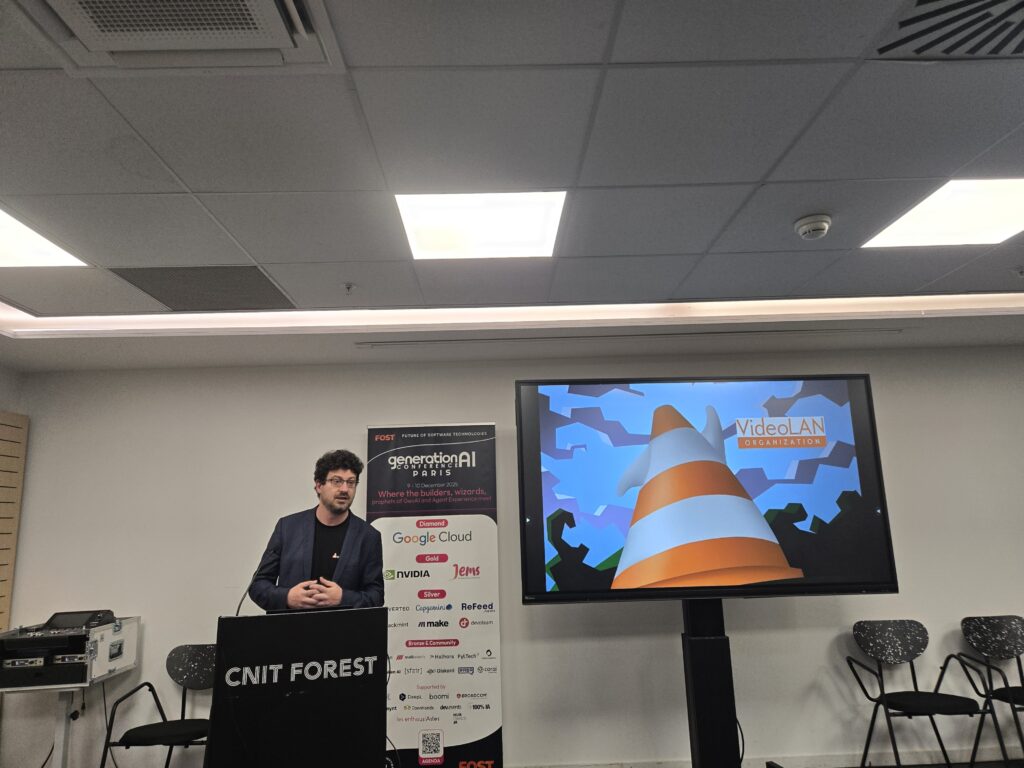
With Jean-Baptiste Kempf (VideoLAN / CEO Kyber / Tech Fellow Scaleway)
The VideoLAN project (VLC) relies on an open-source community that finds extrinsic motivation in the project. Members enjoy participating in a project close to their interests (video games, anime, etc.). When it comes to an AI project, how do we create that same motivation?
Furthermore, the creation of an AI involves vastly different economic scales. A project like VLC costs about €0.5 million to produce; an open-source browser costs €2 to €3 billion. For an open-source LLM, we are looking at €500 million.
This raises the question of the sovereignty of the AIs created. While many of these AIs rely on open-source building blocks, the value is essentially captured at the final application layer, without compensation for the underlying blocks and dependencies. Few models today are truly “open source” (most remain “open weight”), and developed open-source models are often several years behind market leaders. The final hurdle is computing power (GPUs), where Europe faces a massive dependency as it does not manufacture them.
Today, the role of communities is found in two specific areas: assisting in the curation of high-quality data and developing Small Language Models.
link to audio
An Independent General Interest AI: What Roles for Communities?
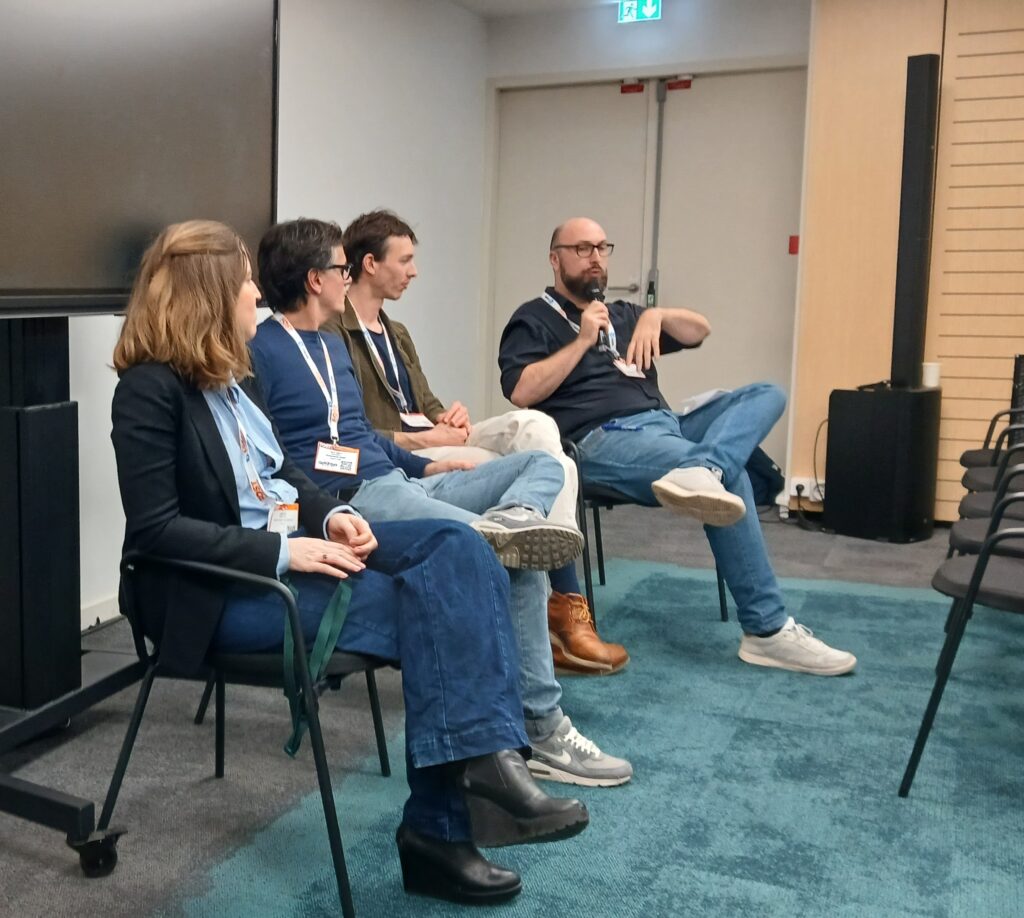
With Jean-Marc Borredon (City of Annemasse), Raphael Bournhonesque (Open Food Facts), Jeanne Bretécher (Social Good Accelerator), Pierre-Yves Gosset (Framasoft), and Jean-Philippe Clément (City of Paris).
The final highlight of Commons AI Day was a round table featuring five speakers sharing their experiences with AI within Social and Solidarity Economy (SSE) associations or local government. Jean-Philippe Clément, creator of the Parlez-moi d’IA podcast, moderated the discussion on actions favoring “AI for the general interest.”
The ideal for such an AI would be: useful, frugal, technically mastered, and open, seeking human fulfillment through a virtuous economic model. But how can we envision it?
For Pierre-Yves Gosset (Framasoft), an “AI for the general interest” does not exist (and will never exist across its entire value chain) for two reasons:
- Concentrated Means of Production: The infrastructure (networks, cables), models, data, and even energy resources belong to an oligopoly of a few companies held by states with opaque policies. As the saying goes: “It’s not AI you hate, it’s capitalism.”
- The Loss of the Commons: The commons associated with general interest AI have lost many battles. Initiatives exist, but at small scales with dwindling financial support. Even if the AI bubble bursts, Big Tech has already created a dependency on tools that are currently “free.”
Proposed Solution: A framework similar to the “5Rs” of waste management, applied to AI in order of priority:
- Refuse AI.
- Reduce AI usage.
- Regulate AI.
- Responsibility (Hold actors accountable).
- Redirect toward “more responsible” AIs.
The SSE Perspective: Governance and Values
For Jeanne Brétécher (Social Good Accelerator), implementing AI in the SSE sector is complex. These organizations are often in a difficult position regarding the digital transition and lack the budgets to make the leap. However, AI is being used to save time in the face of limited resources.
The SSE could offer what AI needs: democratic governance, fair value sharing, a counter-discourse to capitalism, and distributed cooperative operations. AI is forcing these organizations to realize they have been dispossessed of their data, prompting a push for data mastery.
Local Government in Action: Sovereignty and Sobriety
Jean-Marc Borredon (Annemasse Agglo) noted that AI reveals a dependency on software vendors, especially when trying to regain control of professional databases. In the public sector, a lack of data culture amplifies this, impacting “cognitive sovereignty”: strategic information will increasingly be imbued with the biases of those who provide the models.
In response, Annemasse Agglo chose a sovereign infrastructure: an open-source, “sober” SLM (Mistral Small 3.2) hosted on a controlled GPU, coupled with an end-to-end controlled RAG (Retrieval-Augmented Generation) system. This approach rests on three pillars—Sovereignty, Sobriety, Utility—formalized in a charter that favors trust over prohibition.
The Technical Reality of Scaling
Raphael Bournhonesque (Open Food Facts) shared an example of reclaiming AI development. Using small models and a modest GPU, they significantly improved image analysis. However, costs remain: server costs are roughly $1,300 per month. Pooling efforts is necessary to lower these prices. Furthermore, the “GPU bubble” includes high obsolescence and variable quality, sometimes requiring entire teams just to keep the hardware running.
Conclusion and Future Outlook
To conclude on an optimistic note, several avenues for action were discussed. The French state (via DINUM) is developing Albert, a tool based on Mistral. To fund the commons, the idea of a “tax credit for the commons” is worth exploring. However, before discussing “General Interest AI,” we must establish a framework for “General Interest Digital Tech.” A first step could be limiting state aid (like the CIR) to companies that primarily use European clouds.
Key Ideas for the Future:
- Establish a “General Interest AI” legal status: Defining a legal framework for useful, frugal, and open AI to engage businesses and users.
- Guarantee Hardware Sovereignty (GPUs): Advocating at the European level for local GPU production to reduce dependency and combat planned obsolescence. This includes making state or private resources available to community and SSE projects.
- Regulate Economic Relations: Implementing strong anti-competitive regulations (similar to the ARCEP model in telecoms) to prevent opaque bilateral agreements between AI giants and content providers.
- Alert on the “New Tragedy of the Commons”: Preventing open data from “closing up” due to fears of data scraping/plundering.
Concrete Collaborations:
- Infrastructure Pooling for SLMs: Creating cooperatives to host Small Language Models, making them more affordable for the SSE and local authorities.
- Standardized Trust Rules: Deploying “trusted data spaces” based on shared governance (interoperability, fair remuneration for contributors).
- Data Trusts: Testing the adaptation of the Data Trust model via existing French legal structures, such as endowment funds (fonds de dotation), to collectively manage data rights.

Special thanks to all the speakers, to Jean-Philippe Clément for organizing the round table and the “Parlez-moi d’IA” episode, and to the organizers of Future of Software Technologies (especially Mehdi Medjaoui and Orianne Durand) for their hospitality.